Entry LXXXIX – October

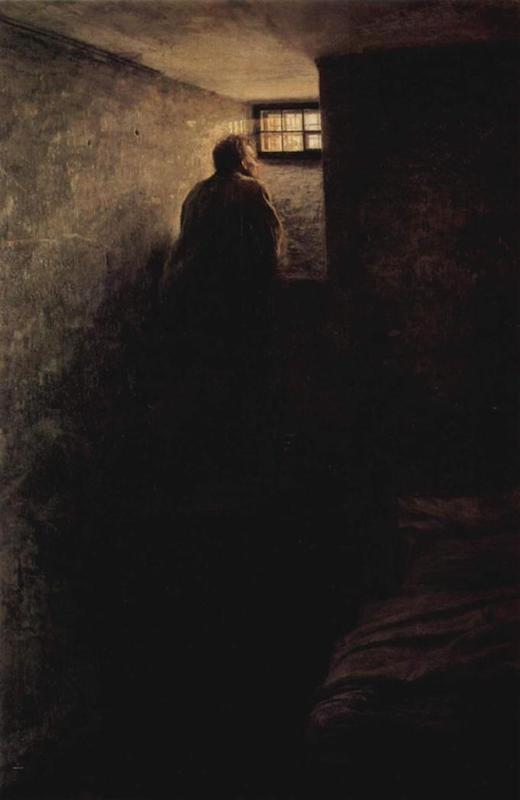
In the prison pen
Herman Melville

Listless he eyes the palisades
And sentries in the glare;
’Tis barren as a pelican-beach—
But his world is ended there.
Nothing to do; and vacant hands
Bring on the idiot-pain;
He tries to think—to recollect,
But the blur is on his brain.
Around him swarm the plaining ghosts
Like those on Virgil’s shore—
A wilderness of faces dim,
And pale ones gashed and hoar.
A smiting sun. No shed, no tree;
He totters to his lair—
A den that sick hands dug in earth
Ere famine wasted there,
Or, dropping in his place, he swoons,
Walled in by throngs that press,
Till forth from the throngs they bear him dead—
Dead in his meagerness.

the-prisoner-1878hd

Entry LXX – May

In Memory of W.B. Yeats
W.H. Auden

I
He disappeared in the dead of winter:
The brooks were frozen, the airports almost deserted,
And snow disfigured the public statues;
The mercury sank in the mouth of the dying day.
What instruments we have agree
The day of his death was a dark cold day.
Far from his illness
The wolves ran on through the evergreen forests,
The peasant river was untempted by the fashionable quays;
By mourning tongues
The death of the poet was kept from his poems.
But for him it was his last afternoon as himself,
An afternoon of nurses and rumours;
The provinces of his body revolted,
The squares of his mind were empty,
Silence invaded the suburbs,
The current of his feeling failed; he became his admirers.
Now he is scattered among a hundred cities
And wholly given over to unfamiliar affections,
To find his happiness in another kind of wood
And be punished under a foreign code of conscience.
The words of a dead man
Are modified in the guts of the living.
But in the importance and noise of to-morrow
When the brokers are roaring like beasts on the floor of the
Bourse,
And the poor have the sufferings to which they are fairly
accustomed,
And each in the cell of himself is almost convinced of his
freedom,
A few thousand will think of this day
As one thinks of a day when one did something slightly unusual.
What instruments we have agree
The day of his death was a dark cold day.

II
You were silly like us; your gift survived it all:
The parish of rich women, physical decay,
Yourself. Mad Ireland hurt you into poetry.
Now Ireland has her madness and her weather still,
For poetry makes nothing happen: it survives
In the valley of its making where executives
Would never want to tamper, flows on south
From ranches of isolation and the busy griefs,
Raw towns that we believe and die in; it survives,
A way of happening, a mouth.


III
Earth, receive an honoured guest:
William Yeats is laid to rest.
Let the Irish vessel lie
Emptied of its poetry.

In the nightmare of the dark
All the dogs of Europe bark,
And the living nations wait,
Each sequestered in its hate;

Intellectual disgrace
Stares from every human face,
And the seas of pity lie
Locked and frozen in each eye.

Follow, poet, follow right
To the bottom of the night,
With your unconstraining voice
Still persuade us to rejoice;

With the farming of a verse
Make a vineyard of the curse,
Sing of human unsuccess
In a rapture of distress;

In the deserts of the heart
Let the healing fountain start,
In the prison of his days
Teach the free man how to praise.

13173955_1680475512227005_8973136035024524947_n

Entry LVIII – May

If We Must Die
Claude McKay

If we must die—let it not be like hogs
Hunted and penned in an inglorious spot,
While round us bark the mad and hungry dogs,
Making their mock at our accursed lot.
If we must die—oh, let us nobly die,
So that our precious blood may not be shed
In vain; then even the monsters we defy
Shall be constrained to honor us though dead!
Oh, Kinsmen! We must meet the common foe;
Though far outnumbered, let us show us brave,
And for their thousand blows deal one deathblow!
What though before us lies the open grave?
Like men we’ll face the murderous, cowardly pack,
Pressed to the wall, dying, but fighting back!

13256137_1685161921758364_798261158130417546_n

Entry VI – April

Jenny Kiss’d Me
Leigh Hunt

Jenny kiss’d me when we met,
Jumping from the chair she sat in; 
Time, you thief, who love to get
Sweets into your list, put that in!
Say I’m weary, say I’m sad,
Say that health and wealth have miss’d me,
Say I’m growing old, but add,
Jenny kiss’d me.

13266038_1685219068419316_8881450066000147445_n.jpg

Entry LII – April

The Wise
Countee Cullen

Dead men are wisest, for they know
How far the roots of flowers go,
How long a seed must rot to grow.

Dead men alone bear frost and rain
On throbless heart and heatless brain,
And feel no stir of joy or pain.

Dead men alone are satiate;
They sleep and dream and have no weight,
To curb their rest, of love or hate.

Strange, men should flee their company,
Or think me strange who long to be
Wrapped in their cool immunity.

13321636_1688399211434635_3368969527707211228_n

Entry XLVIII – March

Annabel Lee
Edgar Allen Poe

It was many and many a year ago,
In a kingdom by the sea,
That a maiden there lived whom you may know
By the name of Annabel Lee;
And this maiden she lived with no other thought
Than to love and be loved by me.

I was a child and she was a child,
In this kingdom by the sea;
But we loved with a love that was more than love-
I and my Annabel Lee;
With a love that the winged seraphs of heaven
Coveted her and me.

And this was the reason that, long ago,
In this kingdom by the sea,
A wind blew out of a cloud, chilling
My beautiful Annabel Lee;
So that her highborn kinsman came
And bore her away from me,
To shut her up in a sepulchre
In this kingdom by the sea.

The angels, not half so happy in heaven,
Went envying her and me-
Yes! – that was the reason (as all men know,
In this kingdom by the sea)
That the wind came out of the cloud by night,
Chilling and killing my Annabel Lee.

But our love it was stronger by far than the love
Of those who were older than we-
Of many far wiser than we-
And neither the angels in heaven above,
Nor the demons down under the sea,
Can ever dissever my soul from the soul
Of the beautiful Annabel Lee.

For the moon never beams without bringing me dreams
Of the beautiful Annabel Lee;
And the stars never rise but I feel the bright eyes
Of the beautiful Annabel Lee;
And so, all the night-tide, I lie down by the side
Of my darling- my darling- my life and my bride,
In the sepulchre there by the sea,
In her tomb by the sounding sea.

13346339_1689202628020960_2823937706843681700_o.jpg

Entry XLIV – February

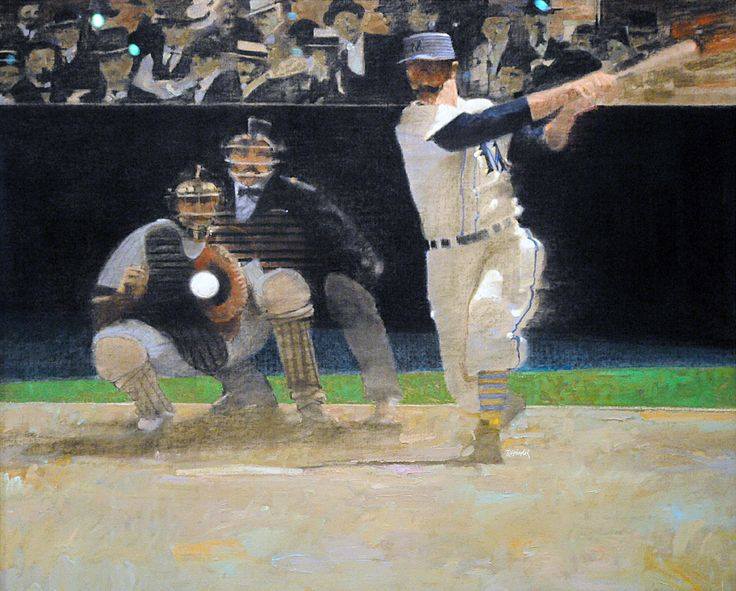
Casey at the Bat
Ernest Lawrence Thayer

The outlook wasn’t brilliant for the Mudville Nine that day;
the score stood four to two, with but one inning more to play.
And then when Cooney died at first, and Barrows did the same,
a sickly silence fell upon the patrons of the game.

A straggling few got up to go in deep despair. The rest
clung to that hope which springs eternal in the human breast;
they thought, if only Casey could get but a whack at that –
they’d put up even money, now, with Casey at the bat.

But Flynn preceded Casey, as did also Jimmy Blake,
and the former was a lulu and the latter was a fake,
so upon that stricken multitude grim melancholy sat,
for there seemed but little chance of Casey’s getting to the bat.

But Flynn let drive a single, to the wonderment of all,
and Blake, the much despised, tore the cover off the ball;
and when the dust had lifted, and the men saw what had occurred,
there was Jimmy safe at second and Flynn a-hugging third.

Then from five thousand throats and more there rose a lusty yell;
it rumbled through the valley, it rattled in the dell;
it knocked upon the mountain and recoiled upon the flat,
for Casey, mighty Casey, was advancing to the bat.

There was ease in Casey’s manner as he stepped into his place;
there was pride in Casey’s bearing and a smile on Casey’s face.
And when, responding to the cheers, he lightly doffed his hat,
no stranger in the crowd could doubt ’twas Casey at the bat.

Ten thousand eyes were on him as he rubbed his hands with dirt;
five thousand tongues applauded when he wiped them on his shirt.
Then while the writhing pitcher ground the ball into his hip,
defiance gleamed in Casey’s eye, a sneer curled Casey’s lip.

And now the leather-covered sphere came hurtling through the air,
and Casey stood a-watching it in haughty grandeur there.
Close by the sturdy batsman the ball unheeded sped–
“That ain’t my style,” said Casey. “Strike one,” the umpire said.

From the benches, black with people, there went up a muffled roar,
like the beating of the storm-waves on a stern and distant shore.
“Kill him! Kill the umpire!” shouted someone on the stand;
and it’s likely they’d have killed him had not Casey raised his hand.

With a smile of Christian charity great Casey’s visage shone;
he stilled the rising tumult; he bade the game go on;
he signaled to the pitcher, and once more the spheroid flew;
but Casey still ignored it, and the umpire said: “Strike two.”

“Fraud!” cried the maddened thousands, and echo answered fraud;
but one scornful look from Casey and the audience was awed.
They saw his face grow stern and cold, they saw his muscles strain,
and they knew that Casey wouldn’t let that ball go by again.

The sneer is gone from Casey’s lip, his teeth are clenched in hate;
he pounds with cruel violence his bat upon the plate.
And now the pitcher holds the ball, and now he lets it go,
and now the air is shattered by the force of Casey’s blow.

Oh, somewhere in this favored land the sun is shining bright;
the band is playing somewhere, and somewhere hearts are light,
and somewhere men are laughing, and somewhere children shout;
but there is no joy in Mudville — mighty Casey has struck out.
13335513_1690020427939180_5897103098178051985_n.jpg