Entry XCIV – January 2019

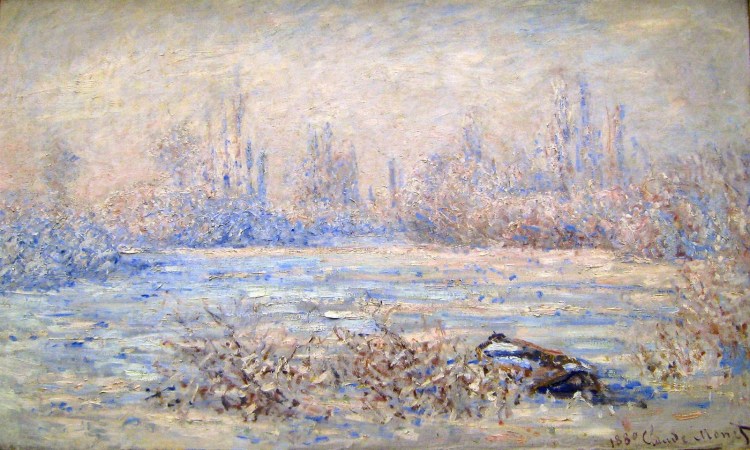
A January Dandelion
George Marion McClellan

All Nashville is a chill. And everywhere
Like desert sand, when the winds blow,
There is each moment sifted through the air,
A powdered blast of January snow.
O! thoughtless Dandelion, to be misled
By a few warm days to leave thy natural bed, 
Was folly growth and blooming over soon.
And yet, thou blasted yellow-coated gem,
Full many a heart has but a common boon
With thee, now freezing on thy slender stem.
When the heart has bloomed by the touch of love’s warm breath
Then left and chilling snow is sifted in,
It still may beat but there is blast and death
To all that blooming life that might have been.

frost-near-vetheuil-1880.jpg!hd

Entry XCII – October

The Love Song of J. Alfred Prufrock

T.S. Eliot

S’io credesse che mia risposta fosse
A persona che mai tornasse al mondo,
Questa fiamma staria senza piu scosse.
Ma percioche giammai di questo fondo
Non torno vivo alcun, s’i’odo il vero,
Senza tema d’infamia ti rispondo. 

Let us go then, you and I,
When the evening is spread out against the sky
Like a patient etherized upon a table;
Let us go, through certain half-deserted streets,
The muttering retreats
Of restless nights in one-night cheap hotels
And sawdust restaurants with oyster-shells:
Streets that follow like a tedious argument
Of insidious intent
To lead you to an overwhelming question …
Oh, do not ask, “What is it?”

Let us go and make our visit.

In the room the women come and go

Talking of Michelangelo.

The yellow fog that rubs its back upon the window-panes,
The yellow smoke that rubs its muzzle on the window-panes,
Licked its tongue into the corners of the evening,
Lingered upon the pools that stand in drains,
Let fall upon its back the soot that falls from chimneys,
Slipped by the terrace, made a sudden leap,
And seeing that it was a soft October night,

Curled once about the house, and fell asleep.

And indeed there will be time
For the yellow smoke that slides along the street,
Rubbing its back upon the window-panes;
There will be time, there will be time
To prepare a face to meet the faces that you meet;
There will be time to murder and create,
And time for all the works and days of hands
That lift and drop a question on your plate;
Time for you and time for me,
And time yet for a hundred indecisions,
And for a hundred visions and revisions,

Before the taking of a toast and tea.

In the room the women come and go

Talking of Michelangelo.

And indeed there will be time
To wonder, “Do I dare?” and, “Do I dare?”
Time to turn back and descend the stair,
With a bald spot in the middle of my hair —
(They will say: “How his hair is growing thin!”)
My morning coat, my collar mounting firmly to the chin,
My necktie rich and modest, but asserted by a simple pin —
(They will say: “But how his arms and legs are thin!”)
Do I dare
Disturb the universe?
In a minute there is time

For decisions and revisions which a minute will reverse.

For I have known them all already, known them all:
Have known the evenings, mornings, afternoons,
I have measured out my life with coffee spoons;
I know the voices dying with a dying fall
Beneath the music from a farther room.

               So how should I presume?

And I have known the eyes already, known them all—
The eyes that fix you in a formulated phrase,
And when I am formulated, sprawling on a pin,
When I am pinned and wriggling on the wall,
Then how should I begin
To spit out all the butt-ends of my days and ways?

               And how should I presume?

And I have known the arms already, known them all—
Arms that are braceleted and white and bare
(But in the lamplight, downed with light brown hair!)
Is it perfume from a dress
That makes me so digress?
Arms that lie along a table, or wrap about a shawl.
               And should I then presume?

               And how should I begin?

Shall I say, I have gone at dusk through narrow streets
And watched the smoke that rises from the pipes

Of lonely men in shirt-sleeves, leaning out of windows? …

I should have been a pair of ragged claws

Scuttling across the floors of silent seas.

And the afternoon, the evening, sleeps so peacefully!
Smoothed by long fingers,
Asleep … tired … or it malingers,
Stretched on the floor, here beside you and me.
Should I, after tea and cakes and ices,
Have the strength to force the moment to its crisis?
But though I have wept and fasted, wept and prayed,
Though I have seen my head (grown slightly bald) brought in upon a platter,
I am no prophet — and here’s no great matter;
I have seen the moment of my greatness flicker,
And I have seen the eternal Footman hold my coat, and snicker,

And in short, I was afraid.

And would it have been worth it, after all,
After the cups, the marmalade, the tea,
Among the porcelain, among some talk of you and me,
Would it have been worth while,
To have bitten off the matter with a smile,
To have squeezed the universe into a ball
To roll it towards some overwhelming question,
To say: “I am Lazarus, come from the dead,
Come back to tell you all, I shall tell you all”—
If one, settling a pillow by her head
               Should say: “That is not what I meant at all;

               That is not it, at all.”

And would it have been worth it, after all,
Would it have been worth while,
After the sunsets and the dooryards and the sprinkled streets,
After the novels, after the teacups, after the skirts that trail along the floor—
And this, and so much more?—
It is impossible to say just what I mean!
But as if a magic lantern threw the nerves in patterns on a screen:
Would it have been worth while
If one, settling a pillow or throwing off a shawl,
And turning toward the window, should say:
               “That is not it at all,

               That is not what I meant, at all.”

No! I am not Prince Hamlet, nor was meant to be;
Am an attendant lord, one that will do
To swell a progress, start a scene or two,
Advise the prince; no doubt, an easy tool,
Deferential, glad to be of use,
Politic, cautious, and meticulous;
Full of high sentence, but a bit obtuse;
At times, indeed, almost ridiculous—

Almost, at times, the Fool.

I grow old … I grow old …

I shall wear the bottoms of my trousers rolled.

Shall I part my hair behind?   Do I dare to eat a peach?
I shall wear white flannel trousers, and walk upon the beach.

I have heard the mermaids singing, each to each.

I do not think that they will sing to me.

I have seen them riding seaward on the waves
Combing the white hair of the waves blown back
When the wind blows the water white and black.
We have lingered in the chambers of the sea
By sea-girls wreathed with seaweed red and brown
Till human voices wake us, and we drown.
Screen Shot 2018-10-23 at 5.26.24 PM.png

Entry XCI – October

Those Winter Sundays

Robert Hayden

Sundays too my father got up early
and put his clothes on in the blueblack cold,
then with cracked hands that ached
from labor in the weekday weather made
banked fires blaze. No one ever thanked him.

I’d wake and hear the cold splintering, breaking.
When the rooms were warm, he’d call,
and slowly I would rise and dress,
fearing the chronic angers of that house,

Speaking indifferently to him,
who had driven out the cold
and polished my good shoes as well.
What did I know, what did I know
of love’s austere and lonely offices?
Screen Shot 2018-10-22 at 10.41.03 PM.png

Entry LXXVI – June

Marching Men
Marjorie Pickthall

Under the level winter sky
I saw a thousand Christs go by.
They sang an idle song and free
As they went up to calvary.

Careless of eye and coarse of lip,
They marched in holiest fellowship.
That heaven might heal the world, they gave
Their earth-born dreams to deck the grave.

With souls unpurged and steadfast breath
They supped the sacrament of death.
And for each one, far off, apart,
Seven swords have rent a woman’s heart.

13177830_1679035315704358_7842693815684581941_n.jpg

Entry LXXI – June

The Dying Hunter to his Dog
Susanna Moore

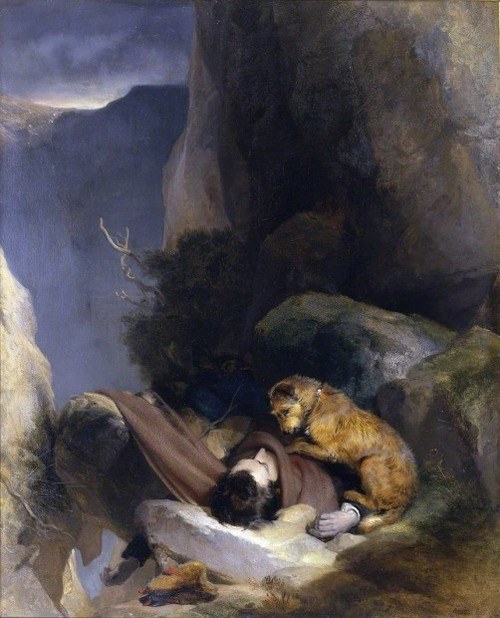
Lie down—lie down!—my noble hound,
That joyful bark give o’er; 
It wakes the lonely echoes round,
But rouses me no more—
Thy lifted ears, thy swelling chest,
Thy eyes so keenly bright,
No longer kindle in my breast
The thrill of fierce delight;
When following thee on foaming steed
My eager soul outstripped thy speed—

Lie down—lie down—my faithful hound!
And watch this night by me,
For thee again the horn shall sound
By mountain, stream, and tree;
And thou along the forest glade,
Shall track the flying deer
When cold and silent, I am laid
In chill oblivion here.
Another voice shall cheer thee on,
And glory when the chase is won.

Lie down—lie down!—my gallant hound!
Thy master’s life is sped;
Go—couch thee on the dewy ground—
’Tis thine to watch the dead.
But when the blush of early day
Is kindling up the sky,
Then speed thee, faithful friend, away,
And to thy mistress hie;
And guide her to this lonely spot,
Though my closed eyes behold her not—

Lie down—lie down!—my trusty hound!
Death comes, and we must part—
In my dull ear strange murmurs sound—
More faintly throbs my heart;
The many twinkling lights of heaven
Scarce glimmer in the blue—
Chill round me falls the breath of even,
Cold on my brow the dew;
Earth, stars, and heavens, are lost to sight—
The chase is o’er!—brave friend, good night!—

13177228_1679392285668661_5404389049222606074_n.jpg

Entry LVII – May

Song: Go and Catch a Falling Star
John Donne
Go and catch a falling star,
    Get with child a mandrake root,
Tell me where all past years are,
    Or who cleft the devil’s foot,
Teach me to hear mermaids singing,
Or to keep off envy’s stinging,
            And find
            What wind
Serves to advance an honest mind.
If thou be’st born to strange sights,
    Things invisible to see,
Ride ten thousand days and nights,
    Till age snow white hairs on thee,
Thou, when thou return’st, wilt tell me,
All strange wonders that befell thee,
            And swear,
            No where
Lives a woman true, and fair.
If thou find’st one, let me know,
    Such a pilgrimage were sweet;
Yet do not, I would not go,
    Though at next door we might meet;
Though she were true, when you met her,
And last, till you write your letter,
            Yet she
            Will be
False, ere I come, to two, or three.
13260262_1685210415086848_2244515751120087640_n.jpg

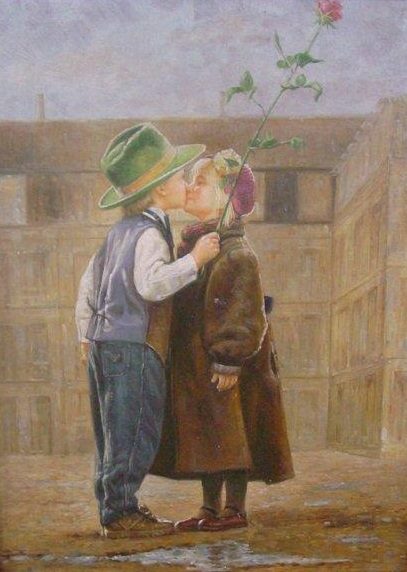
Entry VI – April

Jenny Kiss’d Me
Leigh Hunt

Jenny kiss’d me when we met,
Jumping from the chair she sat in; 
Time, you thief, who love to get
Sweets into your list, put that in!
Say I’m weary, say I’m sad,
Say that health and wealth have miss’d me,
Say I’m growing old, but add,
Jenny kiss’d me.

13266038_1685219068419316_8881450066000147445_n.jpg

Entry XLVIII – March

Annabel Lee
Edgar Allen Poe

It was many and many a year ago,
In a kingdom by the sea,
That a maiden there lived whom you may know
By the name of Annabel Lee;
And this maiden she lived with no other thought
Than to love and be loved by me.

I was a child and she was a child,
In this kingdom by the sea;
But we loved with a love that was more than love-
I and my Annabel Lee;
With a love that the winged seraphs of heaven
Coveted her and me.

And this was the reason that, long ago,
In this kingdom by the sea,
A wind blew out of a cloud, chilling
My beautiful Annabel Lee;
So that her highborn kinsman came
And bore her away from me,
To shut her up in a sepulchre
In this kingdom by the sea.

The angels, not half so happy in heaven,
Went envying her and me-
Yes! – that was the reason (as all men know,
In this kingdom by the sea)
That the wind came out of the cloud by night,
Chilling and killing my Annabel Lee.

But our love it was stronger by far than the love
Of those who were older than we-
Of many far wiser than we-
And neither the angels in heaven above,
Nor the demons down under the sea,
Can ever dissever my soul from the soul
Of the beautiful Annabel Lee.

For the moon never beams without bringing me dreams
Of the beautiful Annabel Lee;
And the stars never rise but I feel the bright eyes
Of the beautiful Annabel Lee;
And so, all the night-tide, I lie down by the side
Of my darling- my darling- my life and my bride,
In the sepulchre there by the sea,
In her tomb by the sounding sea.

13346339_1689202628020960_2823937706843681700_o.jpg

Entry XXXVII – December

Giacometti’s Dog
Robert Wallace

Lopes in bronze:
scruffy, 
thin. In
the Museum of Modern Art
head
down, neck long as sadness
lowering to hanging ears
– he’s eyeless-
that hear
nothing, and the sausage
muzzle
that leads him as
surely as eyes:
he might
be
dead, dried webs or clots of flesh
and fur
on the thin, long bones- but
isn’t, obviously
is obviously
traveling intent on his
own aims: legs
lofting
with a gayety the dead aren’t known
for, Going
onward in one place,
he doesn’t so much ignore
as not recognize
the well-
dressed Sunday hun-
dreds who passing, pausing make
his bronze
road
move. Why
do they come to admire
him?
They wouldn’t care for real dogs
less raggy
than he
is? It’s his tragic
insouciance
bugs them? or is
it that art can make us
cherish
anything- this command
of shaping and abutting space-
that makes us love
even mutts,
even the world, accep
even
the starry wheels by which we’re hurled
toward death, having
the rocks and
wind for comrades?
It’s not this starved hound,
but Giacometti seeing
him we see.
We’ll stand in line all day
to see one man
love anything enough.

13346814_1691030241171532_4934493298762178754_n.jpg