Entry XIX – February

Snake
D.H. Lawrence


A snake came to my water-trough
On a hot, hot day, and I in pajamas for the heat,
To drink there.
In the deep, strange-scented shade of the great dark carob-tree
I came down the steps with my pitcher
And must wait, must stand and wait, for there he was at the trough before me.

He reached down from a fissure in the earth-wall in the gloom
And trailed his yellow-brown slackness soft-bellied down, over the edge of the stone trough
And rested his throat upon the stone bottom,
And where the water had dripped from the tap, in a small clearness,
He sipped with his straight mouth,
Softly drank through his straight gums, into his slack long body,
Silently.

Someone was before me at my water-trough,
And I, like a second comer, waiting.

He lifted his head from his drinking, as cattle do,
And looked at me vaguely, as drinking cattle do,
And flickered his two-forked tongue from his lips, and mused a moment,
And stooped and drank a little more,
Being earth-brown, earth-golden from the burning bowels of the earth
On the day of Sicilian July, with Etna smoking.
The voice of my education said to me
He must be killed,
For in Sicily the black, black snakes are innocent, the gold are venomous.

And voices in me said, If you were a man
You would take a stick and break him now, and finish him off.

But must I confess how I liked him,
How glad I was he had come like a guest in quiet, to drink at my water-trough
And depart peaceful, pacified, and thankless,
Into the burning bowels of this earth?

Was it cowardice, that I dared not kill him? Was it perversity, that I longed to talk to him? Was it humility, to feel so honoured?
I felt so honoured.

And yet those voices:
If you were not afraid, you would kill him!

And truly I was afraid, I was most afraid, But even so, honoured still more
That he should seek my hospitality
From out the dark door of the secret earth.

He drank enough
And lifted his head, dreamily, as one who has drunken,
And flickered his tongue like a forked night on the air, so black,
Seeming to lick his lips,
And looked around like a god, unseeing, into the air,
And slowly turned his head,
And slowly, very slowly, as if thrice a dream,
Proceeded to draw his slow length curving round
And climb again the broken bank of my wall-face.

And as he put his head into that dreadful hole,
And as he slowly drew up, snake-easing his shoulders, and entered farther,
A sort of horror, a sort of protest against his withdrawing into that horrid black hole,
Deliberately going into the blackness, and slowly drawing himself after,
Overcame me now his back was turned.

I looked round, I put down my pitcher,
I picked up a clumsy log
And threw it at the water-trough with a clatter.

I think it did not hit him,
But suddenly that part of him that was left behind convulsed in undignified haste.
Writhed like lightning, and was gone
Into the black hole, the earth-lipped fissure in the wall-front,
At which, in the intense still noon, I stared with fascination.

And immediately I regretted it.
I thought how paltry, how vulgar, what a mean act!
I despised myself and the voices of my accursed human education.

And I thought of the albatross
And I wished he would come back, my snake.

For he seemed to me again like a king,
Like a king in exile, uncrowned in the underworld,
Now due to be crowned again.

And so, I missed my chance with one of the lords
Of life.
And I have something to expiate:
A pettiness.
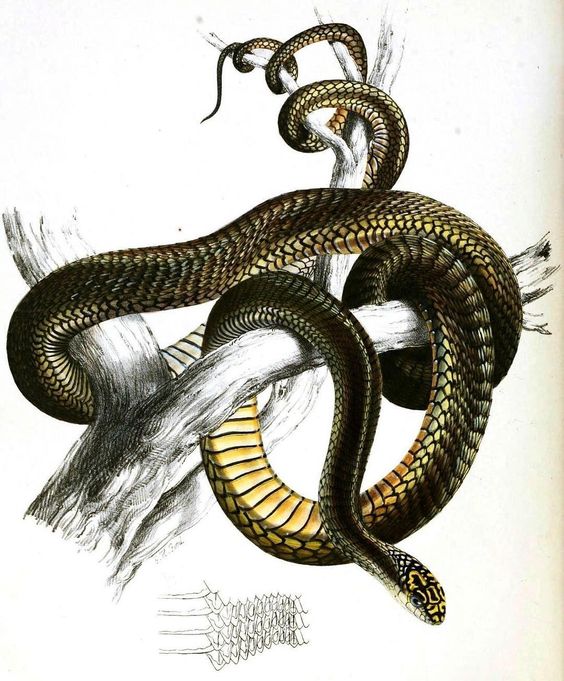
Entry XVIII – February

from An Explanation of America: A Love of Death
Robert Pinsky

Imagine a child from Virginia or New Hampshire
Alone on the prairie eighty years ago
Or more, one afternoon—the shaggy pelt
Of grasses, for the first time in that child’s life,
Flowing for miles. Imagine the moving shadow
Of a cloud far off across that shadeless ocean,
The obliterating strangeness like a tide
That pulls or empties the bubble of the child’s
Imaginary heart. No hills, no trees.

The child’s heart lightens, tending like a bubble
Towards the currents of the grass and sky,
The pure potential of the clear blank spaces.

Or, imagine the child in a draw that holds a garden
Cupped from the limitless motion of the prairie,
Head resting against a pumpkin, in evening sun.
Ground-cherry bushes grow along the furrows,
The fruit red under its papery, moth-shaped sheath.
Grasshoppers tumble among the vines, as large
As dragons in the crumbs of pale dry earth.
The ground is warm to the child’s cheek, and the wind
Is a humming sound in the grass above the draw,
Rippling the shadows of the red-green blades.
The bubble of the child’s heart melts a little,
Because the quiet of that air and earth
Is like the shadow of a peaceful death—
Limitless and potential; a kind of space
Where one dissolves to become a part of something
Entire … whether of sun and air, or goodness
And knowledge, it does not matter to the child.
Dissolved among the particles of the garden
Or into the motion of the grass and air,
Imagine the child happy to be a thing.

Imagine, then, that on that same wide prairie
Some people are threshing in the terrible heat
With horses and machines, cutting bands
And shoveling amid the clatter of the threshers,
The chaff in prickly clouds and the naked sun
Burning as if it could set the chaff on fire.
Imagine that the people are Swedes or Germans,
Some of them resting pressed against the strawstacks,
Trying to get the meager shade.
A man,
A tramp, comes laboring across the stubble
Like a mirage against that blank horizon,
Laboring in his torn shoes toward the tall
Mirage-like images of the tilted threshers
Clattering in the heat. Because the Swedes
Or Germans have no beer, or else because
They cannot speak his language properly,
Or for some reason one cannot imagine,
The man climbs up on a thresher and cuts bands
A minute or two, then waves to one of the people,
A young girl or a child, and jumps head-first
Into the sucking mouth of the machine,
Where he is wedged and beat and cut to pieces—
While the people shout and run in the clouds of chaff,
Like lost mirages on the pelt of prairie.

The obliterating strangeness and the spaces
Are as hard to imagine as the love of death …
Which is the love of an entire strangeness,
The contagious blankness of a quiet plain.
Imagine that a man, who had seen a prairie,
Should write a poem about a Dark or Shadow
That seemed to be both his, and the prairie’s—as if
The shadow proved that he was not a man,
But something that lived in quiet, like the grass.
Imagine that the man who writes that poem,
Stunned by the loneliness of that wide pelt,
Should prove to himself that he was like a shadow
Or like an animal living in the dark.
In the dark proof he finds in his poem, the man
Might come to think of himself as the very prairie,
The sod itself, not lonely, and immune to death.

None of this happens precisely as I try
To imagine that it does, in the empty plains,
And yet it happens in the imagination
Of part of the country: not in any place
More than another, on the map, but rather
Like a place, where you and I have never been
And need to try to imagine—place like a prairie
Where immigrants, in the obliterating strangeness,
Thirst for the wide contagion of the shadow
Or prairie—where you and I, with our other ways,
More like the cities or the hills or trees,
Less like the clear blank spaces with their potential,
Are like strangers in a place we must imagine.

Entry XCII – October

The Love Song of J. Alfred Prufrock

T.S. Eliot

S’io credesse che mia risposta fosse
A persona che mai tornasse al mondo,
Questa fiamma staria senza piu scosse.
Ma percioche giammai di questo fondo
Non torno vivo alcun, s’i’odo il vero,
Senza tema d’infamia ti rispondo. 

Let us go then, you and I,
When the evening is spread out against the sky
Like a patient etherized upon a table;
Let us go, through certain half-deserted streets,
The muttering retreats
Of restless nights in one-night cheap hotels
And sawdust restaurants with oyster-shells:
Streets that follow like a tedious argument
Of insidious intent
To lead you to an overwhelming question …
Oh, do not ask, “What is it?”

Let us go and make our visit.

In the room the women come and go

Talking of Michelangelo.

The yellow fog that rubs its back upon the window-panes,
The yellow smoke that rubs its muzzle on the window-panes,
Licked its tongue into the corners of the evening,
Lingered upon the pools that stand in drains,
Let fall upon its back the soot that falls from chimneys,
Slipped by the terrace, made a sudden leap,
And seeing that it was a soft October night,

Curled once about the house, and fell asleep.

And indeed there will be time
For the yellow smoke that slides along the street,
Rubbing its back upon the window-panes;
There will be time, there will be time
To prepare a face to meet the faces that you meet;
There will be time to murder and create,
And time for all the works and days of hands
That lift and drop a question on your plate;
Time for you and time for me,
And time yet for a hundred indecisions,
And for a hundred visions and revisions,

Before the taking of a toast and tea.

In the room the women come and go

Talking of Michelangelo.

And indeed there will be time
To wonder, “Do I dare?” and, “Do I dare?”
Time to turn back and descend the stair,
With a bald spot in the middle of my hair —
(They will say: “How his hair is growing thin!”)
My morning coat, my collar mounting firmly to the chin,
My necktie rich and modest, but asserted by a simple pin —
(They will say: “But how his arms and legs are thin!”)
Do I dare
Disturb the universe?
In a minute there is time

For decisions and revisions which a minute will reverse.

For I have known them all already, known them all:
Have known the evenings, mornings, afternoons,
I have measured out my life with coffee spoons;
I know the voices dying with a dying fall
Beneath the music from a farther room.

               So how should I presume?

And I have known the eyes already, known them all—
The eyes that fix you in a formulated phrase,
And when I am formulated, sprawling on a pin,
When I am pinned and wriggling on the wall,
Then how should I begin
To spit out all the butt-ends of my days and ways?

               And how should I presume?

And I have known the arms already, known them all—
Arms that are braceleted and white and bare
(But in the lamplight, downed with light brown hair!)
Is it perfume from a dress
That makes me so digress?
Arms that lie along a table, or wrap about a shawl.
               And should I then presume?

               And how should I begin?

Shall I say, I have gone at dusk through narrow streets
And watched the smoke that rises from the pipes

Of lonely men in shirt-sleeves, leaning out of windows? …

I should have been a pair of ragged claws

Scuttling across the floors of silent seas.

And the afternoon, the evening, sleeps so peacefully!
Smoothed by long fingers,
Asleep … tired … or it malingers,
Stretched on the floor, here beside you and me.
Should I, after tea and cakes and ices,
Have the strength to force the moment to its crisis?
But though I have wept and fasted, wept and prayed,
Though I have seen my head (grown slightly bald) brought in upon a platter,
I am no prophet — and here’s no great matter;
I have seen the moment of my greatness flicker,
And I have seen the eternal Footman hold my coat, and snicker,

And in short, I was afraid.

And would it have been worth it, after all,
After the cups, the marmalade, the tea,
Among the porcelain, among some talk of you and me,
Would it have been worth while,
To have bitten off the matter with a smile,
To have squeezed the universe into a ball
To roll it towards some overwhelming question,
To say: “I am Lazarus, come from the dead,
Come back to tell you all, I shall tell you all”—
If one, settling a pillow by her head
               Should say: “That is not what I meant at all;

               That is not it, at all.”

And would it have been worth it, after all,
Would it have been worth while,
After the sunsets and the dooryards and the sprinkled streets,
After the novels, after the teacups, after the skirts that trail along the floor—
And this, and so much more?—
It is impossible to say just what I mean!
But as if a magic lantern threw the nerves in patterns on a screen:
Would it have been worth while
If one, settling a pillow or throwing off a shawl,
And turning toward the window, should say:
               “That is not it at all,

               That is not what I meant, at all.”

No! I am not Prince Hamlet, nor was meant to be;
Am an attendant lord, one that will do
To swell a progress, start a scene or two,
Advise the prince; no doubt, an easy tool,
Deferential, glad to be of use,
Politic, cautious, and meticulous;
Full of high sentence, but a bit obtuse;
At times, indeed, almost ridiculous—

Almost, at times, the Fool.

I grow old … I grow old …

I shall wear the bottoms of my trousers rolled.

Shall I part my hair behind?   Do I dare to eat a peach?
I shall wear white flannel trousers, and walk upon the beach.

I have heard the mermaids singing, each to each.

I do not think that they will sing to me.

I have seen them riding seaward on the waves
Combing the white hair of the waves blown back
When the wind blows the water white and black.
We have lingered in the chambers of the sea
By sea-girls wreathed with seaweed red and brown
Till human voices wake us, and we drown.
Screen Shot 2018-10-23 at 5.26.24 PM.png

Entry LXX – May

In Memory of W.B. Yeats
W.H. Auden

I
He disappeared in the dead of winter:
The brooks were frozen, the airports almost deserted,
And snow disfigured the public statues;
The mercury sank in the mouth of the dying day.
What instruments we have agree
The day of his death was a dark cold day.
Far from his illness
The wolves ran on through the evergreen forests,
The peasant river was untempted by the fashionable quays;
By mourning tongues
The death of the poet was kept from his poems.
But for him it was his last afternoon as himself,
An afternoon of nurses and rumours;
The provinces of his body revolted,
The squares of his mind were empty,
Silence invaded the suburbs,
The current of his feeling failed; he became his admirers.
Now he is scattered among a hundred cities
And wholly given over to unfamiliar affections,
To find his happiness in another kind of wood
And be punished under a foreign code of conscience.
The words of a dead man
Are modified in the guts of the living.
But in the importance and noise of to-morrow
When the brokers are roaring like beasts on the floor of the
Bourse,
And the poor have the sufferings to which they are fairly
accustomed,
And each in the cell of himself is almost convinced of his
freedom,
A few thousand will think of this day
As one thinks of a day when one did something slightly unusual.
What instruments we have agree
The day of his death was a dark cold day.

II
You were silly like us; your gift survived it all:
The parish of rich women, physical decay,
Yourself. Mad Ireland hurt you into poetry.
Now Ireland has her madness and her weather still,
For poetry makes nothing happen: it survives
In the valley of its making where executives
Would never want to tamper, flows on south
From ranches of isolation and the busy griefs,
Raw towns that we believe and die in; it survives,
A way of happening, a mouth.


III
Earth, receive an honoured guest:
William Yeats is laid to rest.
Let the Irish vessel lie
Emptied of its poetry.

In the nightmare of the dark
All the dogs of Europe bark,
And the living nations wait,
Each sequestered in its hate;

Intellectual disgrace
Stares from every human face,
And the seas of pity lie
Locked and frozen in each eye.

Follow, poet, follow right
To the bottom of the night,
With your unconstraining voice
Still persuade us to rejoice;

With the farming of a verse
Make a vineyard of the curse,
Sing of human unsuccess
In a rapture of distress;

In the deserts of the heart
Let the healing fountain start,
In the prison of his days
Teach the free man how to praise.

13173955_1680475512227005_8973136035024524947_n

Entry XLIV – February

Casey at the Bat
Ernest Lawrence Thayer

The outlook wasn’t brilliant for the Mudville Nine that day;
the score stood four to two, with but one inning more to play.
And then when Cooney died at first, and Barrows did the same,
a sickly silence fell upon the patrons of the game.

A straggling few got up to go in deep despair. The rest
clung to that hope which springs eternal in the human breast;
they thought, if only Casey could get but a whack at that –
they’d put up even money, now, with Casey at the bat.

But Flynn preceded Casey, as did also Jimmy Blake,
and the former was a lulu and the latter was a fake,
so upon that stricken multitude grim melancholy sat,
for there seemed but little chance of Casey’s getting to the bat.

But Flynn let drive a single, to the wonderment of all,
and Blake, the much despised, tore the cover off the ball;
and when the dust had lifted, and the men saw what had occurred,
there was Jimmy safe at second and Flynn a-hugging third.

Then from five thousand throats and more there rose a lusty yell;
it rumbled through the valley, it rattled in the dell;
it knocked upon the mountain and recoiled upon the flat,
for Casey, mighty Casey, was advancing to the bat.

There was ease in Casey’s manner as he stepped into his place;
there was pride in Casey’s bearing and a smile on Casey’s face.
And when, responding to the cheers, he lightly doffed his hat,
no stranger in the crowd could doubt ’twas Casey at the bat.

Ten thousand eyes were on him as he rubbed his hands with dirt;
five thousand tongues applauded when he wiped them on his shirt.
Then while the writhing pitcher ground the ball into his hip,
defiance gleamed in Casey’s eye, a sneer curled Casey’s lip.

And now the leather-covered sphere came hurtling through the air,
and Casey stood a-watching it in haughty grandeur there.
Close by the sturdy batsman the ball unheeded sped–
“That ain’t my style,” said Casey. “Strike one,” the umpire said.

From the benches, black with people, there went up a muffled roar,
like the beating of the storm-waves on a stern and distant shore.
“Kill him! Kill the umpire!” shouted someone on the stand;
and it’s likely they’d have killed him had not Casey raised his hand.

With a smile of Christian charity great Casey’s visage shone;
he stilled the rising tumult; he bade the game go on;
he signaled to the pitcher, and once more the spheroid flew;
but Casey still ignored it, and the umpire said: “Strike two.”

“Fraud!” cried the maddened thousands, and echo answered fraud;
but one scornful look from Casey and the audience was awed.
They saw his face grow stern and cold, they saw his muscles strain,
and they knew that Casey wouldn’t let that ball go by again.

The sneer is gone from Casey’s lip, his teeth are clenched in hate;
he pounds with cruel violence his bat upon the plate.
And now the pitcher holds the ball, and now he lets it go,
and now the air is shattered by the force of Casey’s blow.

Oh, somewhere in this favored land the sun is shining bright;
the band is playing somewhere, and somewhere hearts are light,
and somewhere men are laughing, and somewhere children shout;
but there is no joy in Mudville — mighty Casey has struck out.

13335513_1690020427939180_5897103098178051985_n.jpg

Entry XXIX – October

The Charge of the Light Brigade
Alfred, Lord Tennyson

1.
Half a league, half a league,
Half a league onward,
All in the valley of Death
Rode the six hundred.
“Forward, the Light Brigade!
“Charge for the guns!” he said:
Into the valley of Death
Rode the six hundred.

2.
“Forward, the Light Brigade!”
Was there a man dismay’d?
Not tho’ the soldier knew
Someone had blunder’d:
Theirs not to make reply,
Theirs not to reason why,
Theirs but to do and die:
Into the valley of Death
Rode the six hundred.

3.
Cannon to right of them,
Cannon to left of them,
Cannon in front of them
Volley’d and thunder’d;
Storm’d at with shot and shell,
Boldly they rode and well,
Into the jaws of Death,
Into the mouth of Hell
Rode the six hundred.

4.
Flash’d all their sabres bare,
Flash’d as they turn’d in air,
Sabring the gunners there,
Charging an army, while
All the world wonder’d:
Plunged in the battery-smoke
Right thro’ the line they broke;
Cossack and Russian
Reel’d from the sabre stroke
Shatter’d and sunder’d.
Then they rode back, but not
Not the six hundred.

5.
Cannon to right of them,
Cannon to left of them,
Cannon behind them
Volley’d and thunder’d;
Storm’d at with shot and shell,
While horse and hero fell,
They that had fought so well
Came thro’ the jaws of Death
Back from the mouth of Hell,
All that was left of them,
Left of six hundred.

6.
When can their glory fade?
O the wild charge they made!
All the world wondered.
Honor the charge they made,
Honor the Light Brigade,
Noble six hundred.

13615033_1701242716816951_2139897763735633613_n.jpg