Entry XCVI – January

For/From Lew
Gary Snyder

Lew Welch just turned up one day,
live as you and me. “Damn, Lew” I said,
“you didn’t shoot yourself after all.”
“Yes I did” he said,
and even then I felt the tingling down my back.
“Yes you did, too” I said—”I can feel it now.”
“Yeah” he said,
“There’s a basic fear between your world and
mine. I don’t know why.
What I came to say was,
teach the children about the cycles.
The life cycles. All other cycles.
That’s what it’s all about, and it’s all forgot.”

Screen Shot 2019-01-25 at 9.21.31 PM.png

Entry XCIII – November

For/From Lew
Gary Snyder

Lew Welch just turned up one day,
live as you and me. “Damn, Lew” I said,
“you didn’t shoot yourself after all.”
“Yes I did” he said,
and even then I felt the tingling down my back.
“Yes you did, too” I said—”I can feel it now.”
“Yeah” he said,
“There’s a basic fear between your world and
mine. I don’t know why.
What I came to say was,
teach the children about the cycles.
The life cycles. All other cycles.
That’s what it’s all about, and it’s all forgot.”

Screen Shot 2018-11-26 at 1.24.34 PM.png

Entry LXXIX – July

Rannoch, by Glencoe
Thomas Stearns Eliot

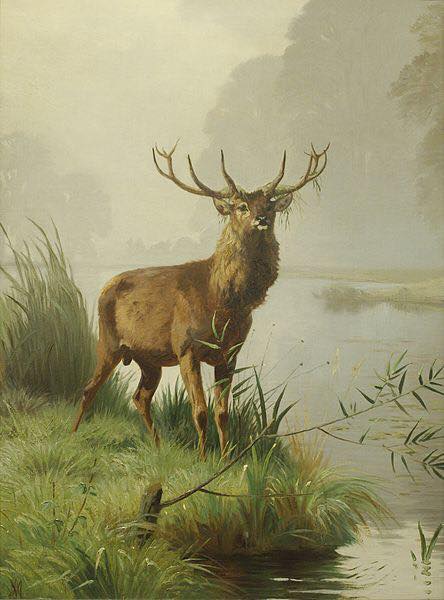
Here the crow starves, here the patient stag
Breeds for the rifle. Between the soft moor
And the soft sky, scarcely room
To leap or soar. Substance crumbles, in the thin air
Moon cold or moon hot. The road winds in
Listlessness of ancient war,
Langour of broken steel,
Clamour of confused wrong, apt
In silence. Memory is strong
Beyond the bone. Pride snapped,
Shadow of pride is long, in the long pass
No concurrence of bone.

13173629_1679033205704569_3671774923315732712_n.jpg

Entry LXXI – June

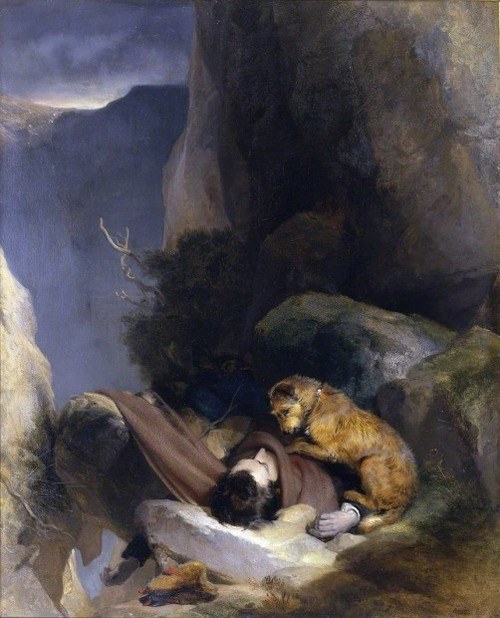
The Dying Hunter to his Dog
Susanna Moore

Lie down—lie down!—my noble hound,
That joyful bark give o’er; 
It wakes the lonely echoes round,
But rouses me no more—
Thy lifted ears, thy swelling chest,
Thy eyes so keenly bright,
No longer kindle in my breast
The thrill of fierce delight;
When following thee on foaming steed
My eager soul outstripped thy speed—

Lie down—lie down—my faithful hound!
And watch this night by me,
For thee again the horn shall sound
By mountain, stream, and tree;
And thou along the forest glade,
Shall track the flying deer
When cold and silent, I am laid
In chill oblivion here.
Another voice shall cheer thee on,
And glory when the chase is won.

Lie down—lie down!—my gallant hound!
Thy master’s life is sped;
Go—couch thee on the dewy ground—
’Tis thine to watch the dead.
But when the blush of early day
Is kindling up the sky,
Then speed thee, faithful friend, away,
And to thy mistress hie;
And guide her to this lonely spot,
Though my closed eyes behold her not—

Lie down—lie down!—my trusty hound!
Death comes, and we must part—
In my dull ear strange murmurs sound—
More faintly throbs my heart;
The many twinkling lights of heaven
Scarce glimmer in the blue—
Chill round me falls the breath of even,
Cold on my brow the dew;
Earth, stars, and heavens, are lost to sight—
The chase is o’er!—brave friend, good night!—

13177228_1679392285668661_5404389049222606074_n.jpg

Entry LXX – May

In Memory of W.B. Yeats
W.H. Auden

I
He disappeared in the dead of winter:
The brooks were frozen, the airports almost deserted,
And snow disfigured the public statues;
The mercury sank in the mouth of the dying day.
What instruments we have agree
The day of his death was a dark cold day.
Far from his illness
The wolves ran on through the evergreen forests,
The peasant river was untempted by the fashionable quays;
By mourning tongues
The death of the poet was kept from his poems.
But for him it was his last afternoon as himself,
An afternoon of nurses and rumours;
The provinces of his body revolted,
The squares of his mind were empty,
Silence invaded the suburbs,
The current of his feeling failed; he became his admirers.
Now he is scattered among a hundred cities
And wholly given over to unfamiliar affections,
To find his happiness in another kind of wood
And be punished under a foreign code of conscience.
The words of a dead man
Are modified in the guts of the living.
But in the importance and noise of to-morrow
When the brokers are roaring like beasts on the floor of the
Bourse,
And the poor have the sufferings to which they are fairly
accustomed,
And each in the cell of himself is almost convinced of his
freedom,
A few thousand will think of this day
As one thinks of a day when one did something slightly unusual.
What instruments we have agree
The day of his death was a dark cold day.

II
You were silly like us; your gift survived it all:
The parish of rich women, physical decay,
Yourself. Mad Ireland hurt you into poetry.
Now Ireland has her madness and her weather still,
For poetry makes nothing happen: it survives
In the valley of its making where executives
Would never want to tamper, flows on south
From ranches of isolation and the busy griefs,
Raw towns that we believe and die in; it survives,
A way of happening, a mouth.


III
Earth, receive an honoured guest:
William Yeats is laid to rest.
Let the Irish vessel lie
Emptied of its poetry.

In the nightmare of the dark
All the dogs of Europe bark,
And the living nations wait,
Each sequestered in its hate;

Intellectual disgrace
Stares from every human face,
And the seas of pity lie
Locked and frozen in each eye.

Follow, poet, follow right
To the bottom of the night,
With your unconstraining voice
Still persuade us to rejoice;

With the farming of a verse
Make a vineyard of the curse,
Sing of human unsuccess
In a rapture of distress;

In the deserts of the heart
Let the healing fountain start,
In the prison of his days
Teach the free man how to praise.
13173955_1680475512227005_8973136035024524947_n

Entry LII – April

The Wise
Countee Cullen

Dead men are wisest, for they know
How far the roots of flowers go,
How long a seed must rot to grow.

Dead men alone bear frost and rain
On throbless heart and heatless brain,
And feel no stir of joy or pain.

Dead men alone are satiate;
They sleep and dream and have no weight,
To curb their rest, of love or hate.

Strange, men should flee their company,
Or think me strange who long to be
Wrapped in their cool immunity.

13321636_1688399211434635_3368969527707211228_n

Entry XLVIII – March

Annabel Lee
Edgar Allen Poe

It was many and many a year ago,
In a kingdom by the sea,
That a maiden there lived whom you may know
By the name of Annabel Lee;
And this maiden she lived with no other thought
Than to love and be loved by me.

I was a child and she was a child,
In this kingdom by the sea;
But we loved with a love that was more than love-
I and my Annabel Lee;
With a love that the winged seraphs of heaven
Coveted her and me.

And this was the reason that, long ago,
In this kingdom by the sea,
A wind blew out of a cloud, chilling
My beautiful Annabel Lee;
So that her highborn kinsman came
And bore her away from me,
To shut her up in a sepulchre
In this kingdom by the sea.

The angels, not half so happy in heaven,
Went envying her and me-
Yes! – that was the reason (as all men know,
In this kingdom by the sea)
That the wind came out of the cloud by night,
Chilling and killing my Annabel Lee.

But our love it was stronger by far than the love
Of those who were older than we-
Of many far wiser than we-
And neither the angels in heaven above,
Nor the demons down under the sea,
Can ever dissever my soul from the soul
Of the beautiful Annabel Lee.

For the moon never beams without bringing me dreams
Of the beautiful Annabel Lee;
And the stars never rise but I feel the bright eyes
Of the beautiful Annabel Lee;
And so, all the night-tide, I lie down by the side
Of my darling- my darling- my life and my bride,
In the sepulchre there by the sea,
In her tomb by the sounding sea.

13346339_1689202628020960_2823937706843681700_o.jpg

Entry XXXIV – November

Mutability
Percy Bysshe Shelley

We are as clouds that veil the midnight moon;
How restlessly they speed and gleam and quiver,
Streaking the darkness radiantly! yet soon
Night closes round, and they are lost for ever:—

We rest—a dream has power to poison sleep;
We rise—one wandering thought pollutes the day;
We feel, conceive or reason, laugh or weep,
Embrace fond woe, or cast our cares away:—

It is the same!—For, be it joy or sorrow,
The path of its departure still is free;
Man’s yesterday may ne’er be like his morrow;
Nought may endure but Mutability.


13498089_1695453887395834_7182950110670279424_o.jpg

Entry XIII – January

13920795_1715895708684985_7478766707833357997_n.jpg
Elegy in a Country Courtyard
G.K. Chesterton
The men that worked for England
They have their graves at home:
And birds and bees of England
About the cross can roam.
But they that fought for England,
Following a falling star,
Alas, alas for England
They have their graves afar.

And they that rule in England,
In stately conclave met,
Alas, alas for England
They have no graves as yet.